
The crowded AI trade that drove returns for much of the year finally broke in July.
Early indications from the PivotalPath Equity Sector TMT Index, the firm’s technology, media, and telecommunications benchmark, fell roughly 10 percent in July, making it the worst-performing of PivotalPath’s 41 indices after leading them through June, up 26.3 percent for the year.
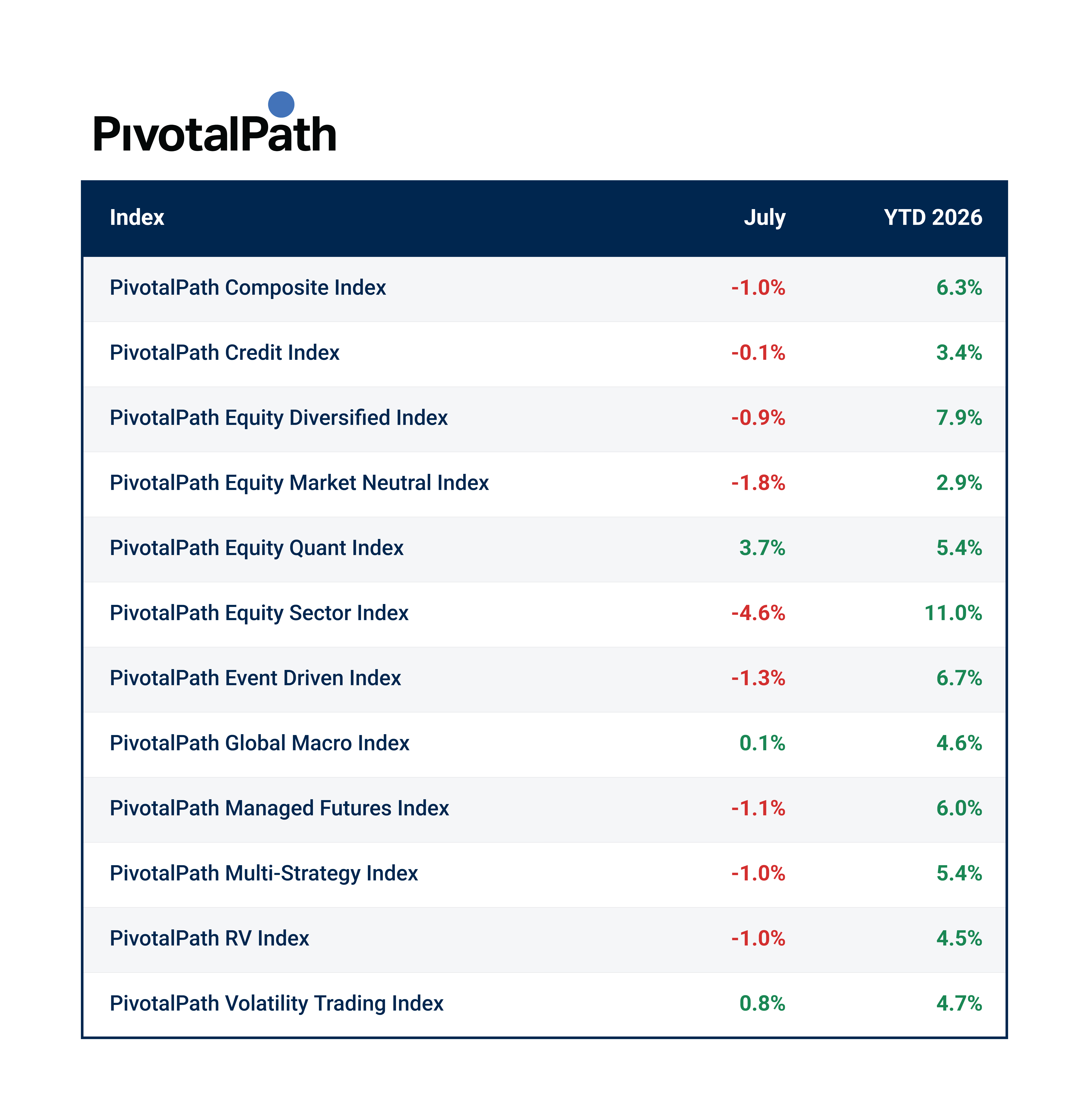
Every month Institutional Investor publishes a subset of hedge fund indices from PivotalPath. Scroll to the end of the article to view 12 indices, including credit, equity diversified, equity market neutral, global macro, relative value, and others.
According to PivotalPath, those managers entered July with historically high exposure to equity beta, momentum stocks, emerging markets, Asian technology, the Nasdaq 100, and crowded trades tracked by Goldman Sachs VIP crowded-longs basket. Those trades reversed at historic speed, led by a 10.6 percent decline in crowded trades and a 10.3 percent decline in the momentum factor. PivotalPath said the index's decline closely matched the 9 percent loss its models had projected during a selloff. In May, Institutional Investor reported that AI was making even tech hedge funds look like the S&P 500. PivotalPath’s data suggested that AI concentration was making it harder for even specialized tech investors to look meaningfully different from the market itself.
“Asia focused equity strategies or funds with Asia tech exposure have been particularly hard hit, with double digit losses,” according to Jon Caplis, CEO. He said that investors who had been viewing Asia as an AI proxy were hurt, in particular, by investments in Korea and Taiwan, which are the center of the semiconductor supply chain.
(Click here for the latest index performance data and access to PivotalPath's full suite of hedge fund indices.)
Hardly an AI Bust
AI, however, is not synonymous with a crowded AI trade. Megacap technology stocks held up, with the PivotalPath FAANG factor up 3.92 percent and the Magnificent 7 factor up 2.07 percent. Most of the losses were in semiconductors and memory. Hedge fund money moved into sectors that have been hurt by AI, such as software: the PivotalPath SaaS Factor rose 17.41 percent, value was up 8.56 percent, and low beta strategies were up 9.88 percent.
Caplis argued the market has become more “dangerous” at a time when the industry is gaining record inflows. He pointed to one sovereign wealth fund committing about $30 billion and the strongest inflows into multi-strategy funds in five years.
July showed that net exposure alone can underestimate risk when managers crowd into the same positions.