Some ideas change an industry. Fewer survive unchanged. In the early 1990s, Eugene Fama and Kenneth French showed that stock returns could be understood partly through shared characteristics, or factors, rather than company stories alone. Their original framework focused on market, size and value factors; later research added profitability and investment, while momentum became another widely used academic factor. Together, these ideas helped establish quantitative investing as a repeatable, evidence-based discipline.
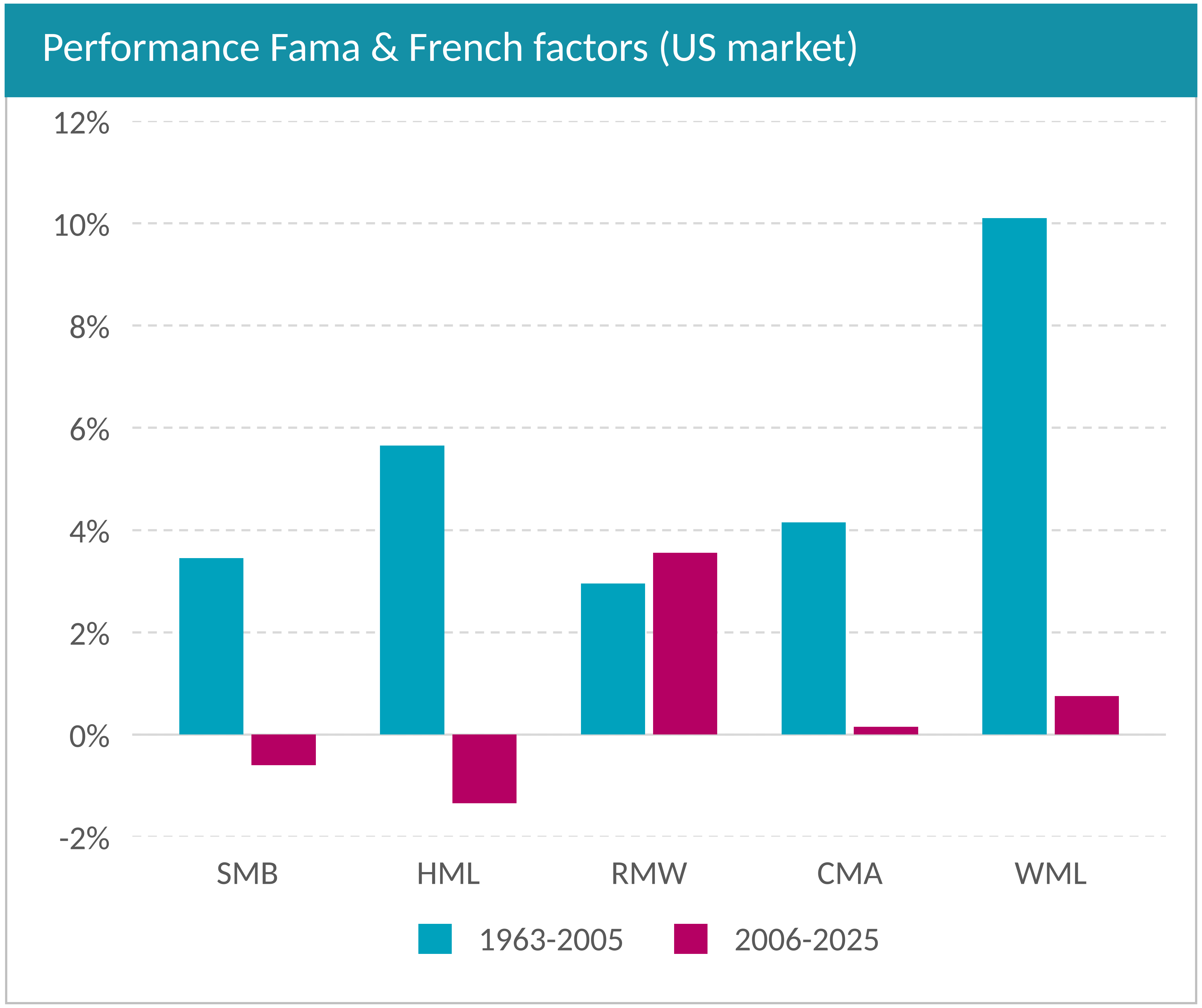
Yet the standard academic recipes have struggled in recent decades. In our analysis of five classic long-short factor portfolios – size, value, profitability, investment and momentum – only profitability produced a meaningful positive return over 2006-2025. This is a stark contrast to all five factors showing positive returns over the four decades leading up to 2005.
These disappointing results don’t necessarily mean the underlying ideas are dead, however. The original formulas may be too blunt for today's markets, but they served as the foundation for a new generation of enhanced factors. These more sophisticated factors start from the same economic intuition but refine how it is measured, control unintended risks and take implementation costs into account. In practice, such innovations can be an effective antidote to factor decay.
When elegant theory meets messy markets
Measured using their standard academic definitions, four of the five classic, non-market factors in our study failed to add value over the past two decades. Size (SMB) and value (HML) were negative from 2006 to 2025. Investment (CMA) and momentum (WML) were approximately flat. Only profitability (RMW) held up – and even that result deserves caution because RMW was added to the Fama-French model in 2015, making part of the evidence in-sample.
Figure 1 | Performance of classic academic US equity factors in two periods

The broader portfolio sorts tell the same story. Across 275 US portfolios formed on pairs of characteristics, fewer than 10% outperformed the market over 2006-2025. In other words, simply sorting stocks more finely did not rescue the generic approach.
Figure 2 | Performance of 275 US factor-sorted portfolios, 2006-2025
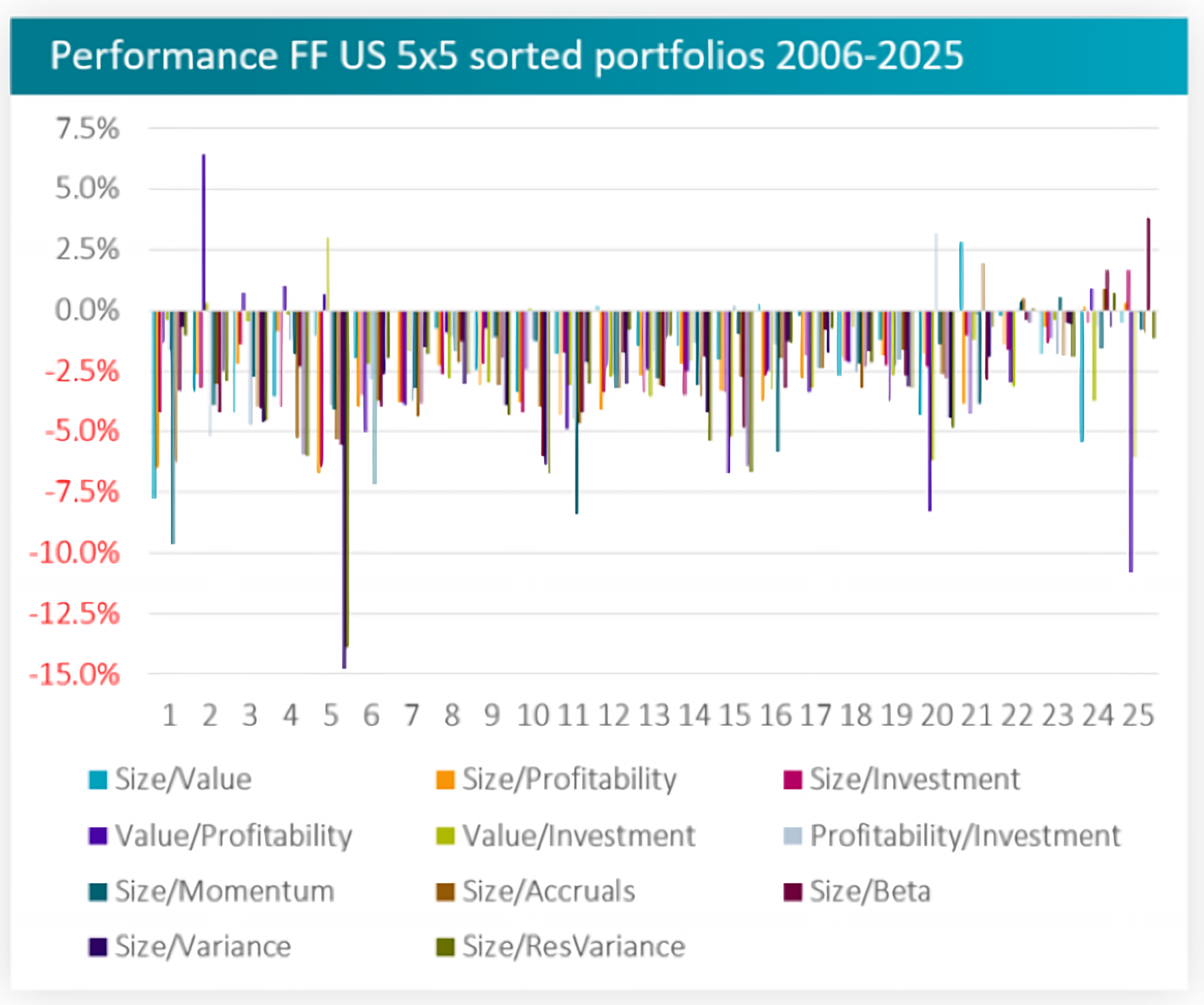
The identity of the few winners is especially revealing. They included the most expensive stocks in the second-lowest profitability bucket and the largest stocks with the highest beta – combinations which run against the usual factor story. If generic sorts were cleanly isolating persistent premia, we might expect winners to cluster in economically intuitive portfolios. Instead, the outcome suggests that simple rules can be overwhelmed by unintended stock, sector and benchmark exposures.
Why generic factors have struggled
The central problem is not necessarily the economic intuition behind a factor, but the way that intuition is encoded. Generic factors typically use fixed accounting ratios, simple cut-offs and mechanical portfolio sorts. Markets, accounting and benchmarks evolve; a formula frozen at one point in time does not. An enhanced factor therefore tries to preserve the original insight while improving its measurement, diversification and implementation.
Value shows the problem clearly. The classic measure relies heavily on book-to-market. That made sense in an economy dominated by industrial companies, but it is less straightforward in a world where a company’s value may lie in software, brands, networks, data, human capital or platform economics. A traditional value screen can therefore end up comparing businesses that are not economically equivalent.
Profitability is one expression of the broader quality idea, but quality itself is not a single factor. It can include margins, balance-sheet strength, earnings stability, capital efficiency, accruals or investment discipline. An enhanced approach asks which measures contain forward-looking information, whether they work across sectors and regions, and whether combining them produces a more robust signal.
Momentum poses a different challenge. The idea is intuitive and persistent: recent winners often continue to outperform for a time. But a naive momentum strategy can suffer severe reversals when market leadership changes, particularly after stress periods. Enhancing this factor means retaining useful trend information while reducing crash risk, crowding and unnecessary turnover.
From factor exposure to factor innovation
Buying a generic factor gives exposure to a published rule. Building an enhanced factor asks harder questions at every layer: Does the economic rationale still hold? Is the signal robust across regions, sectors and market regimes? Is it distorted by accounting, crowding or concentration? Does it add information alongside other signals? And, after risk controls and trading costs, can the portfolio capture the expected return?
Those questions turn factor investing from a one-off discovery into an ongoing research process. Over time, an experienced manager's model may retain the same broad philosophy while using more discriminating definitions, additional signals and more efficient implementation. At Robeco, the correlation between our current enhanced-indexing models and earlier versions has declined as refinements accumulated, indicating that ongoing research can make a live model different from its ancestor without abandoning the original investment philosophy.
Making this distinction is important when it comes to assessing performance. Although Robeco was inspired by the original Fama-French research in the 1990s, most of the relative performance in our current quantitative strategies cannot be explained by traditional factor definitions alone. In our analysis, it reflects proprietary enhancements to established factors, newer signals and the way those inputs are combined and implemented.
New data, tested rigorously
Modern quantitative investors are constantly searching for and incorporating new data. Such signals are not always included in academic models, partly because they may not have data histories going back to the 1960s. Today, there is a wealth of data beyond market prices and financial statements used as the basis for Fama-French, such as analyst revisions, short interest, seasonality, short-term reversal, alternative data and machine-learning-based signals.
However, for a quant practitioner, successfully translating new data into ongoing returns is not simply a matter of incorporating it into an existing academic framework. New signals need to be economically sensible, statistically robust, implementable and additive after costs.
Short-term signals illustrate this point well. They may contain meaningful information, but they can also require more trading. Implemented naively, transaction costs can consume much of the gross alpha. Implemented intelligently, however, they can complement longer-term signals, diversify the alpha engine and improve net outcomes.
This makes portfolio construction an integral element of factor investing. How signals are combined, risk is allocated, turnover is controlled and expected alpha is balanced against expected trading costs are all essential to performance. A strong signal can disappoint if implementation is weak. A more modest signal can add value if it is diversified, efficiently traded and properly integrated.
A foundation, not a finished product
So, is Fama-French still relevant? Yes – as a foundation, not as a finished investment product. The framework established a powerful way of thinking about systematic returns. But the disappointing recent performance of generic definitions shows why an academic portfolio is not the same thing as a robust, investable strategy.
The lasting lesson of Fama-French is not that investors should keep buying the same factors forever, but that markets can be studied systematically. Success depends on applying that lesson: refining established signals, testing new ones, and building portfolios capable of turning research into repeatable performance.
To learn more about Robeco’s investment approach, click here.
Author

David Blitz, Chief Researcher Quant Equity Research Team, Robeco
Important information – Capital at risk
This information refers only to general information about Robeco Holding B.V. and/or its related, affiliated and subsidiary companies (“Robeco”), Robeco's approach, strategies and capabilities. This is a marketing communication solely intended for professional investors, defined as investors qualifying as professional clients, who have requested to be treated as professional clients or who are authorized to receive such information under any applicable laws. Unless otherwise stated, the data and information reported is sourced from Robeco, is, to the best knowledge of Robeco, accurate at the time of publication and comes without any warranties of any kind. Any opinion expressed is solely Robeco’s opinion, it is not a factual statement, and is subject to change, and in no way constitutes investment advice. This document is intended only to provide an overview of Robeco's approach and strategies. It is not a substitute for a prospectus or any other legal document concerning any specific financial instrument. The data, information, and opinions contained herein do not constitute and, under no circumstances, may be construed as an offer or an invitation or a recommendation to make investments or divestments or a solicitation to buy, sell, hold or subscribe for financial instruments or as financial, legal, tax, or investment research advice or as an invitation or to make any other use of it. All rights relating to the information in this document are and will remain the property of Robeco. This document may not be copied or used with the public. No part of this document may be reproduced or published in any form or by any means without Robeco's prior written permission. Robeco Institutional Asset Management B.V. has a license as manager of UCITS and AIFs of the Netherlands Authority for the Financial Markets in Amsterdam.
Parts of the marketing material may involve the use of AI-assisted tools to support the creation and review of marketing materials. These tools are designed to help ensure greater consistency and efficiency. All outcomes are reviewed by human evaluators.
US
This document may be distributed in the US by Robeco Institutional Asset Management US, Inc. (“Robeco US”), an investment adviser registered with the US Securities and Exchange Commission (SEC). Such registration should not be interpreted as an endorsement or approval of Robeco US by the SEC. Robeco B.V. is considered “participating affiliate” and some of their employees are “associated persons” of Robeco US as per relevant SEC no-action guidance. Employees identified as associated persons of Robeco US perform activities directly or indirectly related to the investment advisory services provided by Robeco US. In those situations, these individuals are deemed to be acting on behalf of Robeco US. SEC regulations are applicable only to clients, prospects and investors of Robeco US. Robeco US is wholly owned subsidiary of ORIX Corporation Europe N.V. (“ORIX”), a Dutch Investment Management Firm located in Rotterdam, the Netherlands. Robeco US is located at 90 Park Avenue, 21st Floor, New York, NY 10016.