
For many corporate defined benefit (DB) plans, a key objective today is refining the liability-hedging allocation to ensure that it provides a robust hedge, manages risk, and generates returns that keep pace with the liability. We think “liability-hedging diversifiers” can help. These asset classes and strategies fall outside the traditional liability-hedging toolkit and range from long-duration securitized assets to multisector credit to portable alpha. In this article, we focus on one liability-hedging diversifier in particular: investment-grade (IG) private credit, or private placements.
Among our key takeaways:
- IG private credit may offer a potentially low-risk way to improve expected returns without fundamentally changing the role of the liability-hedging portfolio. It may also help manage issuer concentration risk and strengthen overall portfolio resilience.
- Today's market environment may make the spread premium on IG private credit more attractive. As higher interest rates have increased yields across public IG markets, private borrowers have also had to offer wider spreads to attract capital.
- In general, we think plans may need to allocate at least 5% – 10% of liability-hedging assets to IG private credit to realize its potential benefits. Those with more liquidity flexibility could be above this range.
Below, we offer our views on common questions about the IG private credit opportunity set, recent market headlines, and key implementation considerations.
Where does IG private credit fit in the overall private credit universe?
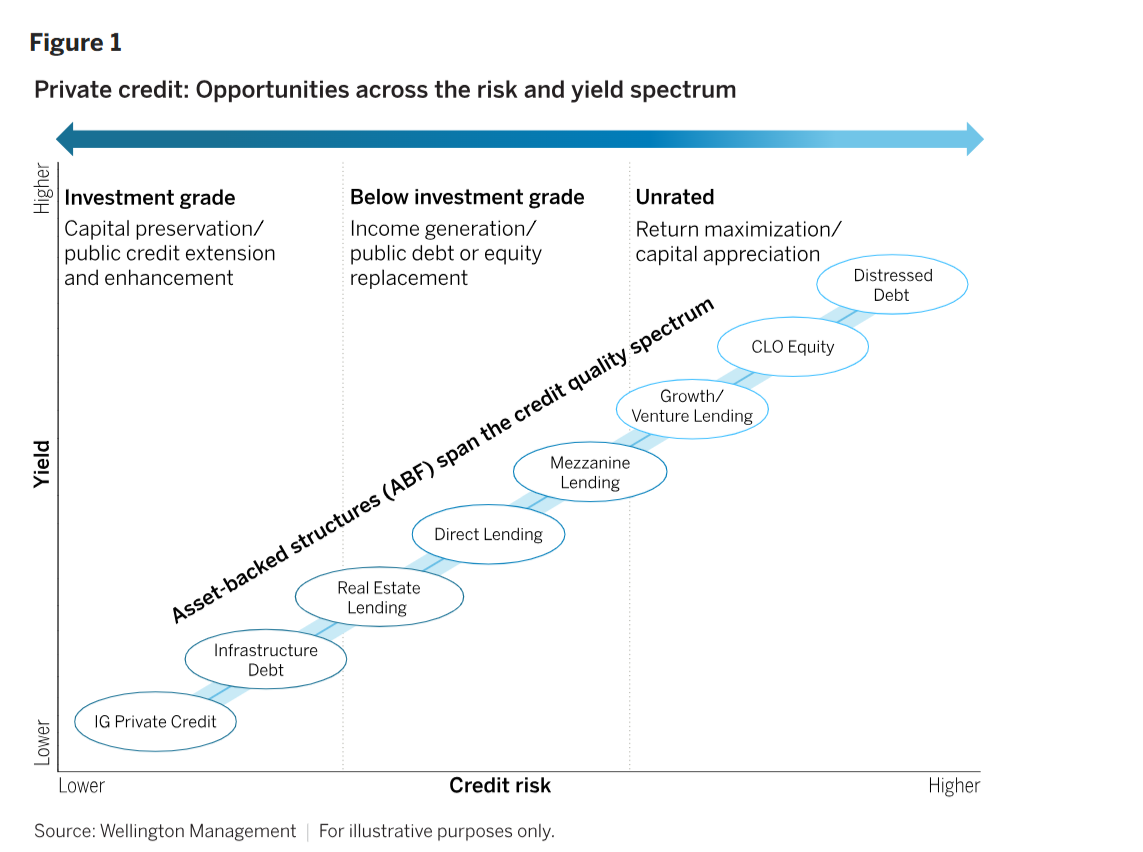
While below-investment-grade direct lending tends to garner a lot of attention, IG private credit occupies a distinct segment of the market (Figure 1). For decades, IG private credit has been used by long-term institutional investors, namely life insurers, seeking to match assets with long-duration liabilities. The market is primarily comprised of investment-grade transactions issued as fixed-rate debt across a broad range of maturities, which we think makes it a natural complement to liability-driven investment strategies centered on IG public credit.
Unlike many areas of private credit that are primarily return-seeking, IG private credit is generally viewed as an extension of a core or liability-hedging fixed income allocation providing income and investment-grade credit exposures. For corporate DB plans, its role is to broaden the liability-hedging opportunity set and seek to improve returns, diversification, and portfolio resiliency.
Can you say more about the potential benefits of an allocation to IG private credit in the liability-hedging portfolio?

We would highlight three in particular:
1. Expanding the opportunity set without adding substantial liability tracking risk
For corporate DB plans, we think the starting point when considering an allocation to IG private credit is to recognize that it may have a nominal impact on projected liability tracking risk given its fixed-rate, investment-grade debt profile. As noted, we often think of it as an extension of the public IG universe.
IG private credit could potentially even help reduce risk at the margins. It brings in a diverse set of issuers with a different sector and geographic footprint than public IG credit, low overlap, and the possibility of non-corporate credit (depending on the fund mandate/guidelines). Alongside corporate issuance, the IG private credit market has continued to expand through infrastructure, project finance, asset-backed, and other structured financing opportunities that we think are well suited to private markets because of their size, complexity, or need for bespoke financing.
2. Seeking the return benefit of being a liquidity provider
A plan with a typical liability profile — even a more mature, frozen plan — is expected to pay out upwards of 40% of its liability more than 10 years from now. This can make plans natural liquidity providers, a position they may want to take advantage of in the IG private credit market.
IG private credit has historically offered additional spread relative to comparable public investment-grade bonds while maintaining similar credit quality and duration characteristics. This incremental spread compensates investors for reduced liquidity, the buy-and-hold nature of the asset class, bespoke transaction structures, and the complexity associated with sourcing and negotiating private investments.
We believe managers with broad sourcing capabilities (including club deals and direct origination, in addition to agented issuance), deep underwriting expertise, and strong structuring capabilities may be well positioned to capture an attractive premium through access to diversified investment opportunities. Spreads close to 100 bps could be a reasonable expectation in our estimation.
Today's market environment may be particularly beneficial for spread premiums. As higher interest rates have increased yields across the IG public market, private borrowers have also had to offer wider spreads to attract capital. As a result, private credit illiquidity premiums have risen above historical averages. For example, the traditional agented market has typically provided approximately 50 basis points of additional spread over comparable public bonds. More recently, that premium has averaged closer to 70 basis points, reflecting the higher-for-longer rate environment and the increasing complexity of borrowers’ financing needs.1
Click here to read the full article, where we cover a variety of other questions including:
- Why might IG private credit’s illiquidity premium be worthwhile for a corporate DB plan?
- How should plans put recent concerns about private credit in context?
- How should plans think about allocation decisions, including sizing and manager selection?
What are the potential trade-offs of a broadly diversified IG private credit portfolio versus a more sector-specific approach (e.g., IG corporates only)?
1Source: Bank of America US Private Placement Market Snapshot, as of June 2026.
The views expressed are those of the authors at the time of writing. Other teams may hold different views and make different investment decisions. The value of your investment may become worth more or less than at the time of original investment. While any third-party data used is considered reliable, its accuracy is not guaranteed. For professional, institutional or accredited investors only.