
The global economy depends on physical and digital systems that operate largely behind the scenes. Power generation and transmission, energy networks, ports, airports, roads, data centers, fiber networks, healthcare facilities, and other essential assets support the services communities, businesses, and governments use every day.
Financing these systems requires substantial long-term capital. For institutional investors, that need is helping move infrastructure debt from a relatively specialized segment of private markets toward a more established portfolio allocation. The asset class combines elements of private credit and real assets, offering exposure to essential infrastructure through loans and other credit instruments that are often supported by contractual or regulated cash flows.
The opportunity, however, is not uniform. Infrastructure debt spans investment-grade, high-yield, and mezzanine strategies, with meaningful differences in capital structure, asset profile, duration, and risk. Investors evaluating the asset class should look beyond the broad infrastructure label and consider how individual transactions are structured, how revenues are generated, and which risks can realistically be mitigated.
Why Infrastructure Financing Needs Are Growing
The scale of required infrastructure investment is significant. The underlying paper cites an estimated $106 trillion of investment needed through 2040 across transportation and logistics, energy and power, digital infrastructure, social infrastructure, waste and water, agriculture, and defense.
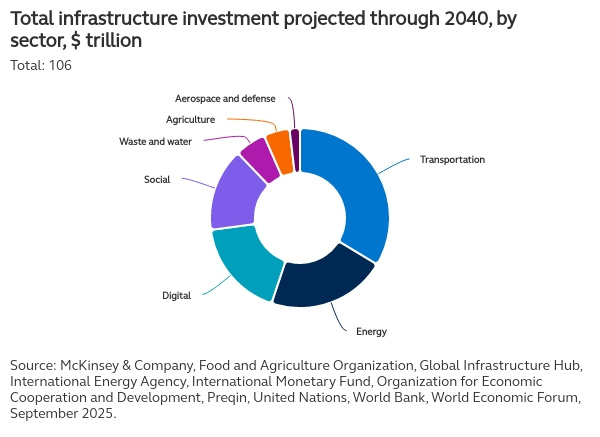
Several forces are expanding that need. Governments face fiscal constraints that may limit their ability to fund infrastructure entirely through public balance sheets. At the same time, energy security, resilient supply chains, strategic control of critical assets, and technological competitiveness have become national priorities in many markets.
Long-term trends are also creating new financing requirements. The energy transition requires investment in generation, storage, transmission, and grid modernization. Digitalization is driving demand for data centers, fiber, wireless networks, and advanced computing infrastructure. In many cases, these trends overlap. For example, growing data center development is increasing electricity demand and placing additional pressure on power generation and transmission systems.

Traditional banks may not be positioned to provide all of the capital required. Regulatory changes and balance-sheet constraints have reduced some banks’ capacity to originate long-duration or complex infrastructure loans. Private lenders and institutional investors are increasingly helping fill that financing gap through directly originated transactions and institutional lending clubs.
What Makes Infrastructure Debt Different
Infrastructure debt consists of directly negotiated loans, notes, and other credit instruments that finance infrastructure assets or operating entities. Although structures vary, the asset class is often distinguished by the nature of the underlying cash flows and the protections built into the financing.
Many infrastructure assets operate under long-term contracts or regulated revenue frameworks. These arrangements may provide greater visibility into future cash flows than investors typically receive from businesses whose revenues are more closely tied to discretionary spending or shorter economic cycles. Some assets also include contractual inflation indexation or regulatory pass-through mechanisms, which may help support income over time.
Creditor protections can provide another important distinction. Infrastructure debt structures may include senior secured claims on assets and cash flows, covenants tied to leverage or coverage metrics, reserve accounts, cash flow controls, and other mechanisms designed to protect lenders. Underwriting often incorporates downside scenarios to assess how much leverage an asset can support under more challenging conditions.
Historical experience further illustrates the potential importance of these characteristics. The paper’s analysis of Moody’s data from 1983 through 2024 shows lower cumulative default and loss rates for corporate infrastructure and project finance than for non-financial corporates across the measurement periods presented. These results do not eliminate the possibility of loss, but they reinforce the importance of essential asset value, contractual cash flows, and structural protections in infrastructure credit analysis.
One Asset Class, Multiple Risk Profiles
Infrastructure debt can serve different portfolio objectives depending on where an investment sits within the capital structure and how the underlying asset generates revenue.
Investment-grade strategies generally focus on senior lending to highly contracted or regulated assets. These allocations may appeal to investors seeking stable income, longer duration, capital preservation, and an alternative to public fixed income.
High-yield infrastructure debt may include assets with partial merchant exposure, shorter contracts, greater sensitivity to demand, growth-related capital needs, or structural subordination. Some opportunities may carry a high-yield classification because of mid-market scale or geographic constraints rather than weak underlying asset fundamentals. These strategies may provide higher income, but investors accept greater variability in cash flows or structural position.
Mezzanine infrastructure debt typically occupies a more junior position beneath senior lenders. The strategy may offer higher return potential, but it can also involve deeper subordination, greater refinancing risk, more variable cash flows, and less certain recovery outcomes.
For investors, defining the intended portfolio role is a critical first step. A core income allocation should be evaluated differently from an income-enhancement or opportunistic allocation. Return targets, liquidity tolerance, credit quality, duration, sector exposure, geography, and position in the capital structure should align with the outcome the investor is seeking.
Managing Risk Requires Looking Beyond the Asset
Infrastructure assets may be essential, but they are not risk-free. Effective underwriting requires investors to separate risks that may be managed through structure from risks that are more difficult to control.
Counterparty quality, cost inflation, operating history, supply or volume exposure, revenue volatility, contract renewal, and construction risk may be evaluated through scenario analysis and addressed through leverage limits, covenants, reserves, cash flow controls, or sponsor support. Other factors, including new technology, political conditions, regulatory permitting, governance, and market adoption, may be less manageable and require greater selectivity.
Manager capabilities are therefore central to the investment case. Direct origination may provide access to differentiated opportunities, but it also places greater responsibility on the lender to structure transactions and monitor assets over time. Investors should assess a manager’s sourcing network, sector capabilities, structuring experience, stress-testing discipline, and ability to respond when an asset performs differently from the original underwriting case.
The quality of an infrastructure investment depends not only on whether the asset is needed, but also on whether the financing appropriately reflects construction, operating, counterparty, regulatory, and market risks.
Looking Ahead
Infrastructure debt is increasingly positioned at the intersection of several enduring investment themes. Governments and businesses need to replace aging infrastructure, expand digital capacity, modernize power systems, and strengthen critical networks. Public capital alone is unlikely to meet the full financing requirement, creating a growing role for private lenders and institutional investors.
For investors, the potential opportunity extends beyond a point-in-time yield advantage. Infrastructure debt may provide a combination of income, contractual or regulated cash flows, creditor protections, long duration, and exposure to real assets with return drivers that differ from traditional corporate credit.
Capturing those benefits requires discipline. Investors should define the role of the allocation, understand the source and durability of asset cash flows, evaluate where risk sits within the capital structure, and select managers with the origination and asset-management capabilities needed to navigate a complex market.
As infrastructure financing needs continue to expand, the debt supporting essential assets may become an increasingly important component of institutional portfolios.