
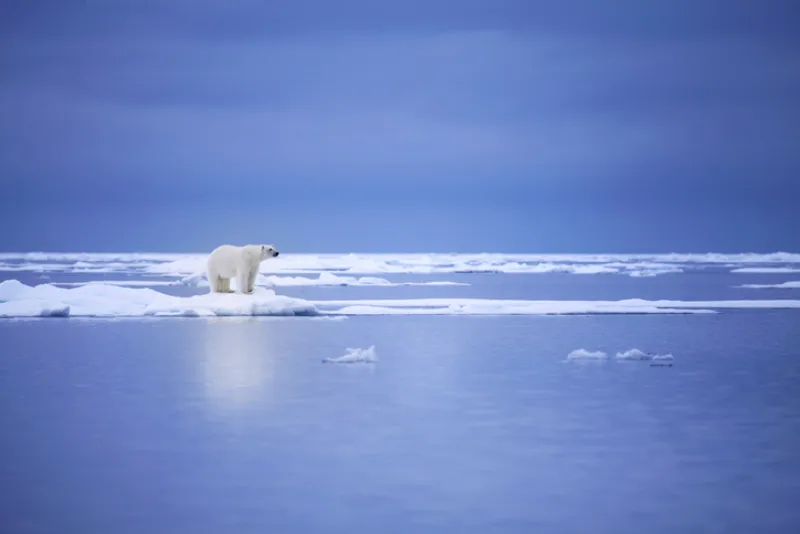
Arctic activity was once focused on collaboration and scientific research. But as the polar ice cap melts, more military vessels than ever traverse northern waters and new commercial shipping lanes are becoming available to those able to navigate the icy waters.
The region is being exploited for minerals and there is a widespread search for fossil fuels underway. And as activity in the region ramps up there is a greater need for more advanced infrastructure development.
As a preview to a fireside chat to be held next month at the Endowments & Foundations Roundtable East 2026 in Boston, and following the release of his book, Polar War, journalist and author Kenneth R. Rosen reflects on years of frontline reporting in the region. The interview explores how economic themes are colliding with military ambition and great‑power rivalry, and what investors need to know before entering the region.
II: Let’s start by discussing the potential for a significant infrastructure play in the Arctic region over the coming years. Guggenheim Investments estimates that $1 trillion will be deployed into projects like ports, highways and communications services. How accurate do you think this number is?
Kenneth R. Rosen: Well, $1 trillion seems like it is not enough. The additional costs of operating in the north cannot be understated.
The cost of getting equipment out to the region, the time that it takes to set it up, and the cost of living to support the crew who would be going out there, is extravagant. Gas prices in the Arctic are also twice what you would see in cities or townships elsewhere.
Developers also have to worry about contingencies. What is built in the Arctic often has to be rebuilt every five years because there hasn't been the expertise necessary to build for long-term sustainable practices in the Arctic.
The Port of Nome in Alaska alone is set to cost $500 million. That one infrastructure project is set to take 10 years, and I guarantee you're going to see delays, overages and a lot of unforeseen issues with construction because the region is just so temperamental. The weather doesn't agree, the light isn't there all the time and companies just don’t have the in-house expertise to pull from.
So do you think that the build out of the Arctic is a big opportunity for investors?
If the pattern that says ‘as the planet warms there will be more activity in the north’ holds true, which it has been, it is a safe bet to say that there will be a return on investment eventually. The Arctic is going to warm and there's going to be more activity after that, that's a certainty.
I think there could be a lot of opportunities. From what I've seen, investors and local governments aren't being as creative as they should be when it comes to exploiting the Arctic for some of the built-in benefits that come with operating in the region.
But I've always wondered why more significant infrastructure for tourism isn’t being built, more rail lines in the north say or more data center construction that could double up as geothermal or hydroelectric plant generators.
Do you think that the competing military ambitions and power rivalries will have a direct impact on this build-out and the flow of capital into the region
I have always said that first the military moves in and then the economy booms. In America there's always been a precedent for that. The American military has a lot of knowledge and capabilities that lay the groundwork for private equity to come in later. And this is just the start of that.
My anticipation is that the notion of military activities in the Arctic will become de rigueur for the next 10 to 20 years and that nations will stake their claims to exclusive economic zones within the region – and then try to build out from there. Once the U.S. figures out how to lock down its Arctic capabilities and its territory, and Canada Norway and Russia do the same, then we will hopefully see some stability. Stability would mean investors could benefit from this year-round military presence and the groundwork being laid.
Are there additional risks associated with investing in the Arctic, be it in infrastructure or otherwise, that an investor wouldn’t have elsewhere?
People think they can turn a quick profit, but the one thing playing against investors that want to work in the Arctic is time. The working season is really only four months of the year, and then the rest is cold and dark and dreary and difficult. That means if you have a project that was prefaced on a 10-year return on investment in a warmer climate, mid-latitude part of the world, double that for the Arctic, or maybe even triple it. You'd need to seek returns in 30 years rather than 10.
New shipping routes are opening up because the ice is thawing, what are the implications of that in terms of global trade flows?
Even though Arctic shipping routes will get busier, for now the insurance costs will cut into what benefits the decrease of transit time and fuel would bring. It could be a boon to global trade, but so long as Russia remains under Western sanctions it's not likely to have a major impact.
You timed the released of your book excellently, given that President Trump’s claims on Greenland came almost immediately after. Do you suspect that the U.S. interest in the Danish territory is based on security, as it claims, or a wish to take control of the region’s well documented mineral supply?
I don't really think there's an opportunity to get access to the minerals in Greenland. If you look at the track record of both American and foreign mining operations in Greenland, they haven't been successful. That is in part because of the short working seasons, the lack of infrastructure and the difficulty of extractive industries in the Arctic.
As Americans we already have what we need from Greenland as far as military security goes. The Pituffik Space Base is a great location, it is the U.S. farthest north military installation, but we don't use it to its fullest extent. One of the discussions that U.S. Congress has been having is about how to benefit from what we already have rather than what we don't have but need.